
|
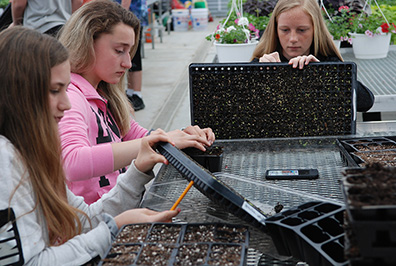 Alyssa Booze, Mya Stahl and Brooklyn Shaw work on seeding plants in the greenhouse. Alyssa Booze, Mya Stahl and Brooklyn Shaw work on seeding plants in the greenhouse. |
“All these tables were built by kids,” Rasmussen said. “That was new to a lot of them. We were a part of the construction process, what goes right and what goes wrong. When I told them at the beginning when the greenhouse was built we would be in the greenhouse every single day, I don’t know if they believed me, but now they’ve seen it.”
The students not only get a classroom grade from the online curriculum, but also get a participation grade in the greenhouse. Classroom time is spent learning about the greenhouse and its possibilities.
“In the classroom we are going to learn the key basics of what we are doing, then they will follow up in the greenhouse,” Rasmussen said. “It’s like a college course where you have classroom and then a lab. This is the lab.”
Things have been a little different this year with getting the finished greenhouse in January and the flood. Rasmussen says next year will be different.
Eighth graders have an exploratory class for one semester in the greenhouse taught by DJ Mottl.
Ryan Woitaszewski is one of the eighth graders taking the small seedlings from a tray of 244 (though not all survived) and putting them in sell packs.
“It’s fun if they aren’t too small,” he said. “You have to be consistent with plants or they will die. You have to fertilize and water them regularly.”
Rasmussen and Mottl work together to get things done in the greenhouse. He has brought other ag classes out to the greenhouse for different units.
“For some it is the first time planting a seed, watching it grow and develop into an actual vegetable they can eat,” Rasmuessen said.
The seniors taking Rasmussen’s class have planted vegetables in the hydroponics.
“Everything in the greenhouse is ‘before the flood’ or ‘after the flood,’” Rasmussen said.
Before the March flood, six pounds of lettuce and 17 pounds of green beans were harvested and served at the NBC lunch room. Then the floods came. By the time they were back in school, the lettuce and beans were past their prime.
Read the full story in the print or e-edition.
<<Back to the front page
