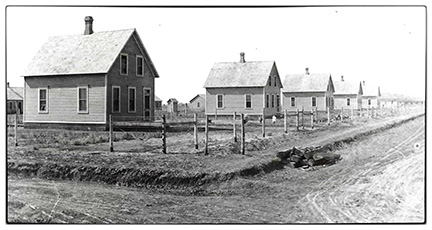
A
row of newly constructed houses await residents in the newly minted town of Leavitt, Nebraska, in 1899.
The Rise and Fall of Sugar City
There was once a town
between North Bend and Ames
with its own dedicated rail line, store, hotel, school and church that was hailed as an economic boon for Dodge County.
Then it disappeared.
This is the story of Leavitt, Nebraska.
by Nathan Arneal
Published 9/13/23
Richard Monte Allen was short, hefty and very British. He wore short trousers buttoned at the knee, boots to the knee and a derby hat. He rode an English Thoroughbred horse with an English saddle and a riding crop that touched his hat in salute to anyone he came across.
But when he opened his mouth, any perception that he was raised in England was erased by a thick Boston accent, one befitting the Harvard graduate that Allen was, class of 1874.
In 1877, Allen went west, at first to Kansas City then into Wyoming Territory in 1879. He learned the cattle trade in Texas, Wyoming and Montana, keeping one gun on his hip holster and another under his arm. In 1881, he became one of the founding partners, along with Col. A.T. Babbitt, of the Standard Cattle Company, originally financed by a group of Chicago businessmen before being sold to a group from Boston. Soon the company had vast cattle ranches in Wyoming and Montana.
The Standard Cattle Company shipped much of its product to New York where it was loaded onto freighters bound for Liverpool, England to provide beef for the island nation.
By 1885, Wyoming was had so many cattle herds that it was difficult to properly fatten a steer. Many companies started to move their herds east to feed and fatten the cattle before sending them to market. The Standard Cattle Company decided it would seek a location that raised plenty of hay and grain for the cattle.
“It was at once agreed,” Allen told the Fremont Daily Tribune for a Dec. 25, 1899, story, “that to give the service demanded, the district in which we would locate must have already developed, to a large extent, its agricultural resources. Dodge County, with its easy access to the South Omaha market, within a day’s run of the Chicago market, filled the bill.”
In January 1886, the company bought 4,500 acres of ground in the Timberville area 6 miles west of Fremont and about 40 miles northwest of Omaha. There was a small depot on the Union Pacific Railroad there named Ketchcum, though with the recent re-establishment of a post office there just a few months earlier in August 1885, the outpost got a new name believed to be borrowed from a U.S. Congressman from Massachusetts who was instrumental in getting the Union Pacific portion of the transcontinental railroad built. His name was Oakes Ames.
In 1886, the transcontinental railroad was still three years from being finished and the village of Ames wasn’t much of a village.
That quickly changed when the Standard Cattle Company moved in and Richard M. Allen was named general manger of the enterprise.
Allen wasted no time in getting right to work building a town. He had two half-mile long streets laid out south of the tracks in the new town of Ames, each with 40 company houses on them. Soon company offices, a blacksmith shop, a telegraph office, a school, boarding houses for single workers and a large general store with a hall to seat 500 on its second story sprung up.
For himself and his wife Virginia, Allen built a 20-room mansion just northwest of the present-day Ames community complete with servant quarters, a liquor room filled from floor to ceiling and a large underground root cellar.
But the most striking feature of the new town was the barn.
The company erected a the largest barn in the United States at a cost of $55,000, a structure covering four acres1 that could house 3,008 head of cattle or 16,000 sheep.
The timing was right for the move. The severe winter of 1886-1887 killed off half the cattle in Wyoming and Montana, according to an article Allen wrote in the 1893-94 issue of The Harvard Graduates Magazine.
The Standard Cattle Company was a blessing for Dodge County farmers, spending hundreds of thousands of dollars on corn and hay to feed the cattle that passed through Ames. The company was known to pay an average of 3 cents more than the market rate for corn. In the early years, the facility handled about 6,000 head of cattle a year, but that figure grew to 70,000 annually as a vast web of feedlots and pens grew around Ames.
Ames may have been named after Oakes Ames, but Richard Allen put it on the map. Allen was not only the man who ran the company that basically founded Ames, but he became a prominent and active citizen known throughout the state. He lobbied hard for the building of drainage and cutoff ditches in Dodge County, a move that many credit with turning the area into the richest farm ground in the world. Allen seemed to get along with everyone, with his personality described as “stirring,” “pleasant” and “charming.”
He was also an astute businessman not afraid to be on the cutting edge.
As the Standard Cattle Company reached full speed in Ames with the completion of the 4-acre barn in 1886, Allen sought ways to make it more profitable.
“It was a short time after the barn was finished,” Allen told the 1899 Herald, “that it became apparent the purpose for which it was constructed would not pay out on the investment, except in the feeding (the cattle) some waste product.”
To find that cheap waste product to feed his cattle, Allen focused on a new crop that was being experimented upon in Nebraska. The sugar beet.
Read the full story in the print or e-edition.
<<Back to the front page |

