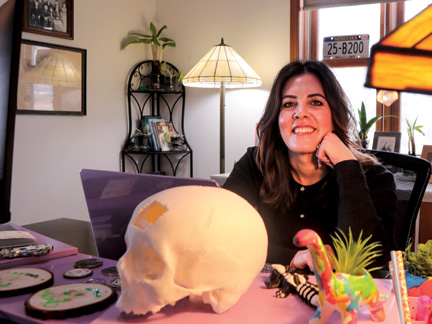
North Bender Stacy Mears uses DNA and family trees to track down criminals and identify unknown bodies. The skull on her desk is a copy of one found in 2017 that may be from an Oregon Trail pioneer whom Mears is trying to identify.
Mears a new kind of detective
by Nathan Arneal
Published 3/11/26
Stacy Mears works as a hairdresser in Omaha four days a week and in her spare time solves murders.
She doesn’t visit crime scenes or interrogate suspects. Her methods are a little unconventional but they have cold case units around the country – including the Omaha Police Department – seeking her out. From her home office just outside of North Bend, Mears uses two primary tools to find suspects when everything else leads to a dead end: DNA and family trees.
The Mears family, Stacy, husband Mike, fifth grader Blaine and kindergartner Charlie live on an acreage about a mile north of North Bend. How they ended up there is an interesting story in itself.
Stacy’s family has had a cabin at Willowwood Lake south of North Bend for a couple decades, so they were familiar with the town.
The Mearses were going to the cabin for the Fourth of July weekend in 2023, but it was raining.
Friend and real estate agent Matthew Heller was holding an open house at a property outside of town and no one was showing up. Since the rain was preventing any swimming that day, the Mearses said they’d swing by the open house and bring Heller a beer.
After hanging out with Heller for a while and watching the rain continue to fall, the family set out for Willowwood. On the way there, Mike turned to Stacy and asked, “Should we buy that house?”
Stacy had recently lost both of her grandfathers, and the idea of moving closer to family in the Abie and Bruno area of Butler County – she is a graduate of David City High – sounded good.
“Why not?”
So they did.
It’s called forensic investigative genetic genealogy, or IGG for short. The concept was introduced around 2011 but did not really start solving cases until about 2015. It leapt into the public eye in 2018 when it was used to identify the Golden State Killer, a serial killer and rapist who terrorized California between 1974 and 1986.
IGG can be used to identify unknown human remains, overturn wrongful convictions or identify a suspect who has left behind DNA at a crime scene.
For example, if a hair is found at a crime scene, it can be used to extract the suspect’s DNA.
That DNA is then compared to a database of DNA profiles such as GEDmatch.com. This database is made up of DNA profiles that have been voluntarily provided by more than 2 million people worldwide. Mears stressed that DNA provided to websites like Ancestry.com or 23andMe.com is not accessible to law enforcement investigators.
“Those databases are off limits to us,” Mears said. “People voluntarily help. There’s a button they have to click that opts into law enforcement.”
GEDmatch is used to find a relative of the unknown DNA sample, if possible. Investigators like Mears can then tell how closely related the match is to the suspect.
The amount of DNA that you share with someone is measured in centimorgans (cM). If two samples share 3,500 cM, then they must be parent-child (or identical twins). Full siblings share about 2,500. Half siblings 1,700. Aunts and uncles, about 1,800.
Let’s say a GEDmatch profile turned up that shared 200 cM of DNA with our suspect. That would make them second cousins.
Then the genealogy begins. Using tools like census records, birth records, obituaries, and these days Facebook profiles, or any other public record, Mears starts to construct a family tree.
She looks for the point where the suspect’s DNA matches come together at a shared common ancestor. Usually, you will have multiple genetic networks that belong to opposite parent sides of the suspect’s family tree. The amount of DNA they each share will tell her how far to build back in their trees.
If she thinks the suspect and a match are second cousins, they would share great grandparents. Once these common ancestors are found from different branches of the suspect’s tree, then Mears will start working down these family trees to find connections where these genetic networks intersect by either marriage or producing a child. This will tell the investigator where the suspect descends from because of the DNA they share with each separate genetic network.
The oldest homicide case Mears has worked was a murder that happened 50 years ago.
“I guess the sense of purpose I get from it is from these families out there who just have no answers,” she said. “I mean, they want to know what happened to their loved one.”
On that particular case, it took Mears and the team of IGG investigators she was working with about five weeks to find the suspect using DNA technology that simply did exist at the time of the murder.
“The DNA technology is always evolving,” Mears said. “It’s crazy. A coupe years ago you couldn’t get DNA from a rootless hair. Now you can.”
Not all her projects are solving crimes. People who were adopted will reach out to Mears for help in locating their birth parents. Last month she helped a man locate his birth father. She then realized that his birth father had the wrong father listed on his birth certificate.
“It was kind of a tangled mess to unravel,” Mears said.
Such messes are not all that uncommon. Mears said about 20% of birth certificates list the wrong father. The DNA doesn’t lie.
Read the full story in the print or e-edition.
<<Back to the front page |

